


Eating Disorders & Intuitive Eating Therapy in Atlanta, GA
Move beyond patterns with food and your body—and rediscover your appetite for life.
Through Somatic Therapy and Intuitive Eating, reconnect with your body’s wisdom and capacity for nourishment. In person Atlanta, GA, online across Georgia

You’re tired of the ongoing battles with food, exercise, and your body—and it may be time to reach for support.
When your days feel weighed down by food and body concerns—
planning meals, avoiding certain foods, thinking about eating constantly, feeling ruled by the scale, tracking every detail, or cycling between restricting and bingeing—it can begin to take over more than just your habits. It can shape how you feel in your body, in your relationships, and in your life.
You might feel caught between wanting change and not knowing how to get there. Maybe you’ve wondered if your struggles are “serious enough,” or you’ve been told you don’t look like you have an eating disorder. Perhaps past treatment felt shaming, rigid, or disconnected from your actual experience.
You may also carry fear—about your health, your future, or how these patterns affect the people you love.
At times, it can feel confusing: part of you wants relief, while another part relies on these patterns to cope, soothe, or feel some sense of control.
Healing from disordered eating is possible but complex because food is necessary for life. This isn’t about simply stopping behaviors, eliminating emotional eating completely, reaching a certain weight, or following rules. It’s about understanding what these patterns have been doing for you—and what deeper needs may be asking for care, attention, and support.
Areas of Expertise
M-Bodied® Therapy offers a trauma-sensitive, relational approach supporting:
-
Your unique ways of thinking, sensing, and engaging with the world are honored as strengths. This work is invitational and adaptable to your needs.
-
HAES® is a weight-inclusive, research-informed framework aligned with compassionate, non-diet, and body-respecting care.
-
Support for anorexia, bulimia, binge eating, ARFID, orthorexia, and OSFED, with guidance on appropriate levels of care and collaboration when needed.
-
Coordination with dietitians, physicians, psychiatrists, and other providers to support your full healing process.
-
Integration of family-supported models to strengthen relational healing and support recovery within the home environment.
Family-Based Treatment (FBT) and Emotion-Focused Family Treatment (EFFT) are evidence-informed approaches that support families in the healing process of eating disorders.
Every individual and family system is unique. Together, we can create a plan that integrates these approaches in a way that feels supportive, flexible, and aligned with your family’s needs—while also coordinating with other members of your treatment team as needed.
All of this work is grounded in a relational, body-based approach that supports lasting change—from the inside out.

Imagine going to the grocery store without tension or second-guessing.
Choosing food without fear.
What if you could sense when your body needs rest—or when it longs for movement—and respond with trust instead of pressure?
What if getting dressed felt like an expression of yourself, rather than something to manage or hide?
As your relationship with food and your body begins to shift, life expands in ways that go far beyond eating.
You may find yourself:
connecting more deeply in relationships
exploring creativity or meaningful work
experiencing moments of ease, satisfaction, and self-trust
Instead of feeling limited by food and body struggles, you begin to discover a fuller relationship with yourself—and a renewed appetite for living.
Why the body’s intelligence matters…
Healing your relationship with food isn’t just about changing behaviors—it’s about understanding the patterns that live in the body.
Many of the struggles around food, movement, and body image are shaped by nervous system patterns, relational experiences, and the ways your body has learned to cope over time. When we begin to work with the body—rather than against it—new possibilities for regulation, choice, and nourishment can emerge.

Many of the patterns that shape your relationship with food, your body, and movement don’t live only in your thoughts—they live in your body.
Long before you had words, your nervous system was learning how to respond to stress, comfort, connection, and need. Over time, these early experiences shape how you relate to hunger, fullness, control, pleasure, and safety.
When your system becomes overwhelmed, it adapts. Bingeing, restricting, emotional eating, or rigid control are not random—they are ways your body has learned to cope, regulate, or protect.
While insight and education can be helpful, they don’t always reach these deeper patterns—and sometimes they can suggest there’s a “right” way to recover.
From a relational and developmental somatic perspective, healing happens through new experiences—especially within a supportive therapeutic relationship.
As your nervous system begins to feel safer, your body can begin to shift. You may start to recognize your unique cues, experience more flexibility with food, and move through urges and emotions with greater steadiness and care.
Over time, you discover your own relationship with Intuitive Eating—one that honors your individuality rather than following a prescribed path.

The Relational, Body-based Work Behind this Approach
Many people come to this work feeling caught in patterns with food, their body, or movement that don’t seem to shift—no matter how much insight or effort they bring. These patterns don’t live only in your thoughts—they live in your body.
Long before you had words, your nervous system was learning how to respond to stress, comfort, connection, and need. Over time, these early experiences shape how you relate to hunger, fullness, control, pleasure, and safety.
When your system becomes overwhelmed, it adapts. Bingeing, restricting, emotional eating, or rigid control around food are not random—they are patterns your body has learned in an effort to cope, regulate, or protect.
While insight and education can be helpful, they don’t always reach these deeper patterns—and sometimes they can suggest there’s a “right” way to recover or nourish yourself.
From a relational and developmental somatic perspective, healing happens through new experiences—especially within a supportive therapeutic relationship. As your nervous system begins to feel safer, your body can begin to shift. You may start to recognize your unique cues, experience more flexibility in how you respond to food, and feel more space to move through urges and emotions with steadiness and care.
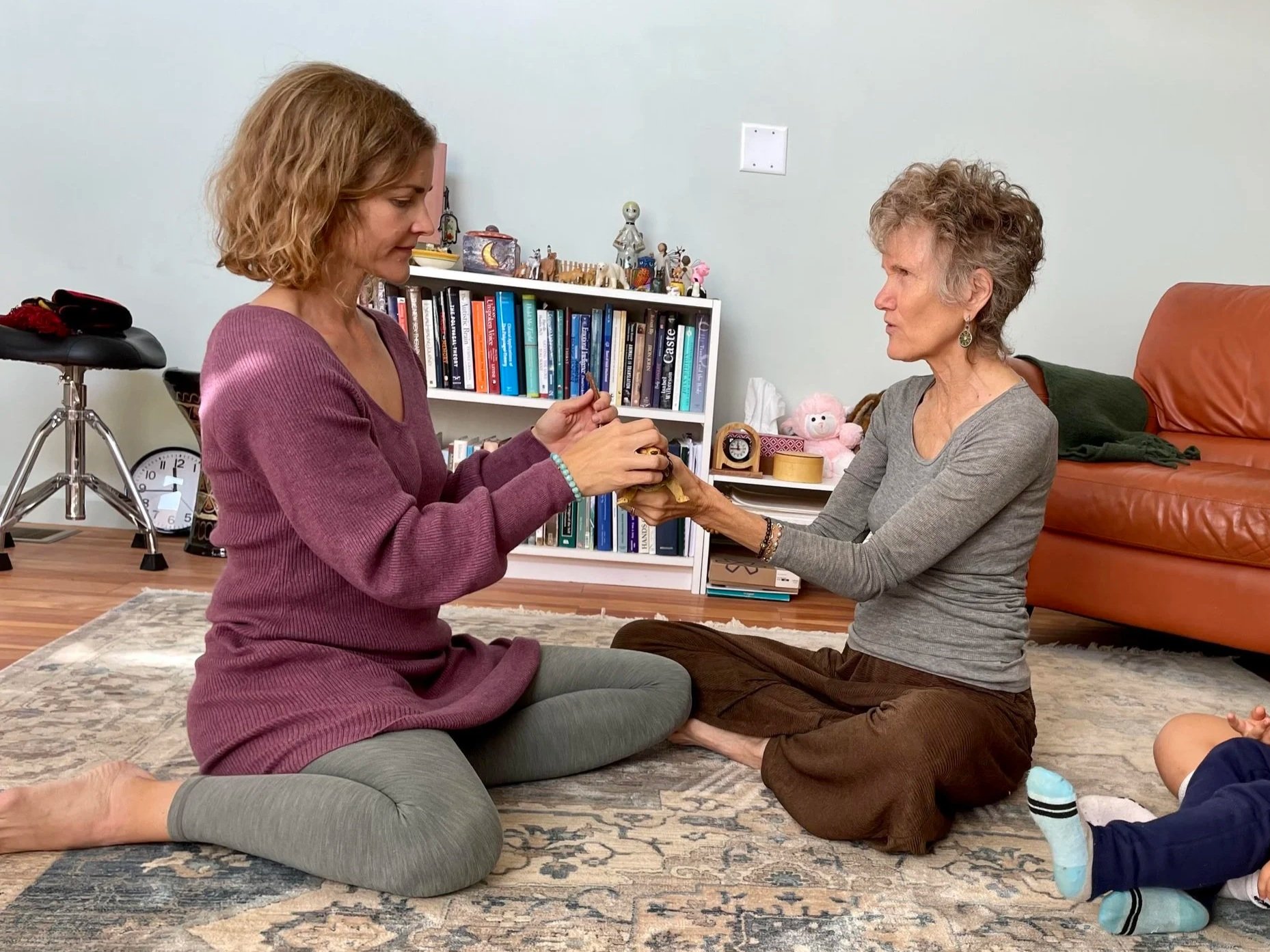
My work is grounded in Chi for Two®, a mindful embodiment method for trauma healing that I helped co-develop and now teach as an ISMETA-Approved Training Program.
Chi for Two is a relational, movement-based approach that supports the body in reclaiming patterns of safety, connection, and play. The name reflects a simple truth: our nervous systems do not heal in isolation. Healing happens through movement, relationship, and the body’s innate capacity to reorganize when it feels safe enough to do so.
This approach weaves together somatic therapy, trauma-informed practices, and mindful movement to help you reconnect with parts of yourself that may have become frozen, inhibited, or disconnected over time.
Within my practice, I bring this work to life through M-Bodied: Mindful Movement as Mothering Medicine®, an approach I created that explores how mindful movement and relational nervous system awareness can support healing and nourishment.
Here, “mothering” is understood as a verb rather than a gender role—the human capacity to nurture, attune, and support life within yourself and in your relationships.
Through this work, healing becomes not just about food or your body—but about restoring vitality, connection, and a fuller appetite for life. For many people, these shifts also begin to influence how they relate to others—including their children—creating new patterns of nourishment and connection over time.
If you're ready for a different relationship with food and your body, you’re welcome to schedule a consultation or reach out to learn more.
Eating Disorder Therapy & Intuitive Eating Counseling can help you…
-
You receive compassionate, individualized support to nourish your body while also tending to your emotional and relational needs.
-
Bingeing, restricting, or habitual emotional eating are approached as meaningful patterns—not failures—creating space for change without shame.
-
You learn to recognize your own cues, rhythms, and needs in ways that honor your individuality, including neurodiverse experiences.
-
Healing happens within connection. A non-shaming therapeutic relationship helps your body move toward greater regulation and attunement.
-
You begin to experience more choice, adaptability, and ease in how you relate to food, exercise, and your body.
-
Food becomes one part of a fuller experience of living—supporting energy, enjoyment, and presence.
-
As your relationship with food and your body shifts, new possibilities for connection, creativity, and fulfillment begin to emerge.

As your relationship with food and exercise begins to shift, your life can expand in meaningful ways.

Frequently Asked Questions
-
A: Intuitive Eating is a process of learning how to better understand your body—your hunger, fullness, needs, and your broader appetite for life. While it’s often described as a non-diet approach, it’s really a deeper, ongoing relationship with how you nourish yourself physically, emotionally, and relationally.
For those in eating disorder recovery, especially during periods of refeeding or medical stabilization, Intuitive Eating is approached with care and flexibility. Rather than following it as a strict framework, we explore the principles in ways that support your unique body, history, and stage of healing.
Over time, this work helps you develop a more attuned, individualized relationship with food and your body.
-
A: I work with individuals across the lifespan and strongly encourage parent or family involvement when working with children, tweens, and teens.
Parents and caregivers are a vital part of the healing process. As young people move through stages like refeeding, stabilization, maintenance, and ongoing development, they benefit from consistent, relational support at home.
While nutrition education and coping skills are important, much of what supports healing happens nonverbally—through co-regulation, attunement, and daily interactions.
When parents receive support as well, they are better equipped to offer steadiness, responsiveness, and connection, which helps create more sustainable change for the whole family.
-
A: Many people struggling with disordered eating—whether bingeing, restricting, purging, emotional eating, or body image distress—find that insight alone doesn’t fully create change.
A somatic approach recognizes that your relationship with food and your body is shaped by your nervous system, life experiences, and learned patterns of coping and protection.
While approaches like CBT, DBT, ACT, FBT, and EFFT can be helpful, integrating a relational, trauma-informed somatic approach supports deeper healing. This includes supporting nervous system regulation, digestive functioning, and your capacity to respond to stress with more flexibility.
This work also draws from early developmental feeding patterns, where trust, attunement, and relational support are foundational. As these experiences are revisited in a safe and supportive environment, your system can begin to shift toward greater regulation—allowing more sustainable eating, movement, and coping patterns to emerge.
-
A: One of the most overlooked challenges is the tendency to focus on behavior or weight change without understanding what those behaviors are communicating.
Rather than approaching recovery through compliance or rigid expectations, this work views eating and exercise patterns as meaningful adaptations—ways your system has learned to cope with overwhelm, distress, or unmet needs.
When these patterns are met with curiosity, compassion, and non-shaming support, new possibilities for healing can emerge.
It’s also important to make space for the parts of you that may feel intense, reactive, or hard to manage. These expressions often need steadiness and support—not suppression.
Through relational and somatic practices, these experiences can be processed, expressed, and integrated in ways that support long-term healing.
-
A: Interoceptive awareness—recognizing internal body cues like hunger, fullness, or emotional states—can vary widely, especially for neurodivergent individuals.
This work is not about forcing awareness in a specific way. Instead, it’s about getting to know how you experience your body, your needs, and the world around you.
Together, we explore individualized ways of noticing, interpreting, and responding to cues—whether those are physical, sensory, emotional, or relational.
This process is grounded in curiosity, flexibility, and respect for your unique experience, rather than a prescriptive or one-size-fits-all approach.
-
A: Not at all. Many people begin this work feeling unsure, ambivalent, or even resistant to change.
Part of the process is making space for all parts of you—including the parts that may rely on current patterns to cope or feel safe.
You don’t have to force readiness. We work at your pace, with curiosity and compassion, allowing change to emerge in a way that feels sustainable and supportive.
